
Access to Healthcare
Annual Behaviour Accountability Report, 2025
Article
28 Aug 2026

2025 was marked by complex health and humanitarian emergencies across Kenya alongside ongoing project work. MSF teams responded to measles, malaria, cholera, and mpox outbreaks, while providing emergency relief following deadly landslides in Elgeyo-Marakwet and treating people injured during anti-government protests in Nairobi and Kisumu. Amid global funding reductions, we maintained essential healthcare and outreach in the Dadaab refugee complex, expanded youth sexual and reproductive health services in Nairobi’s informal settlements, and continued specialized care for chronic conditions, tuberculosis, and kala azar in Homa Bay, Wajir, and Marsabit counties.
The humanitarian landscape in Dadaab refugee complex evolved amid global funding reductions. Humanitarian organisations and communities worked to mitigate the risk of deteriorating living conditions and reduced access to healthcare. Our teams in Dagahaley camp, within the Dadaab complex, continued to deliver general healthcare and specialist referrals, working at health posts and conducting outreach activities to increase access to care.

Select a region or project to view local activities and highlights.
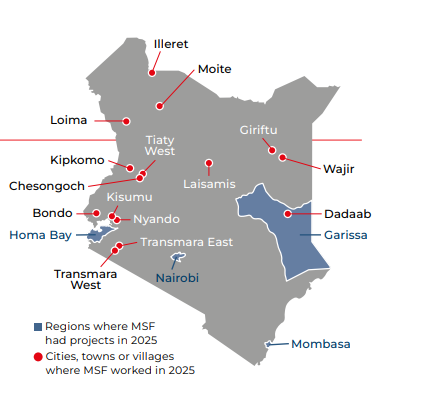
Médecins Sans Frontières responded to multiple emergencies in Kenya, including disease outbreaks, devastating landslides, and violent unrest. We also continued our regular projects, delivering lifesaving care to refugees and remote communities.
In response to measles outbreaks in Tiaty West and Moite, Marsabit county, we worked closely with the local health authorities to provide treatment. In Turkana county, in March, we launched a six-week response to tackle a surge in malaria cases. In Wajir and Marsabit counties, we worked to reduce deaths from kala azar.
The humanitarian landscape in Dadaab refugee complex evolved amid global funding reductions. Our teams in Dagahaley camp, within the Dadaab complex, continued to deliver general healthcare and specialist referrals, working at health posts and conducting outreach activities to increase access to care.
In the capital, Nairobi, we expanded our youth-friendly sexual and reproductive health services by running mobile clinics in the city’s informal settlements. We assisted with cholera responses in Nairobi and Narok by setting up treatment centres, donating medical supplies, conducting community awareness-raising activities, and improving water and sanitisation facilities.
Following deadly landslides in Elgeyo-Marakwet county, we provided emergency medical support, referrals, vaccinations, and relief items. In Homa Bay, our teams offered general, specialist, and palliative care, and supported hospitals with treatment for tuberculosis and non-communicable diseases.
In Mombasa, we supported the response to an mpox outbreak by providing inpatient care and vaccinations, expanding bed capacity for isolation, and improving infection prevention measures in Utange hospital.
In response to measles outbreaks in Tiaty West and Moite, Marsabit county, we worked closely with the local health authorities to provide treatment, vaccinations for children, and awareness-raising activities, and to strengthen epidemiological surveillance. In Turkana county, in March, we launched a six-week response to tackle a surge in malaria cases. As well as offering treatment, our teams distributed mosquito nets and trained community health promoters to test for the disease in remote villages. We assisted with cholera responses in Nairobi and Narok by setting up treatment centres, donating medical supplies, conducting community awareness-raising activities, and improving water and sanitisation facilities.

children vaccinated
In response to measles outbreaks in Tiaty West and Moite, teams worked closely with local health authorities to provide treatment, conduct awareness-raising activities, and strengthen epidemiological surveillance.
emergency response
Launched an intervention to tackle a surge in malaria cases. MSF teams treated patients, distributed mosquito nets, and trained local community health promoters to test for the disease in highly remote villages.
counties supported
Assisted with severe cholera responses by setting up dedicated treatment centres, donating vital medical supplies, conducting community awareness, and improving local water and sanitisation (WASH) facilities.
"By equipping community health promoters with testing kits and mosquito nets, we ensure that even the most remote villages can combat a surge in malaria before it reaches the hospital doors."
Turkana County Outbreak Response
In Wajir and Marsabit counties, we worked to reduce deaths from kala azar, a neglected tropical disease caused by the bite of sand flies, by strengthening treatment, water and sanitation services, and preventive measures in Wajir and Loglogo hospitals. In Mombasa, we supported the response to an mpox outbreak by providing inpatient care and vaccinations, expanding bed capacity for isolation, and improving infection prevention measures in Utange hospital.

Meanwhile, in the capital, Nairobi, we expanded our youth-friendly sexual and reproductive health services by running mobile clinics in the city’s informal settlements. We also assisted people with violence-related injuries sustained in anti-government protests in Nairobi and Kisumu, through ambulance referrals and treatment at the trauma clinic in Eastlands. In Homa Bay, our teams offered general, specialist, and palliative care, and supported hospitals with treatment for tuberculosis and non-communicable diseases.
MSF remains committed to responding to evolving emergencies and healthcare gaps across Kenya. As global funding reductions pressure humanitarian spaces like Dadaab, we will continue adapting our operations to protect access to care, respond to sudden disease outbreaks and natural disasters, and maintain vital urban and specialized medical services.


